
 Tiếng Việt
 日本語
日本語
MobilityTech Asia – Bangkok brings together automotive manufacturers, technology companies, and industry experts to discuss the trends shaping the future of mobility. As part of the event, Future MOVE Forum 2026 served as a dedicated platform for exploring the latest innovations in automotive technology and intelligent mobility. Dr. Nguyen Quoc Tuan, CEO of Vietsol, took the stage as a speaker to present how virtualization technology accelerates the development of Advanced Driver Assistance Systems (ADAS) and Software-Defined Vehicles (SDVs).
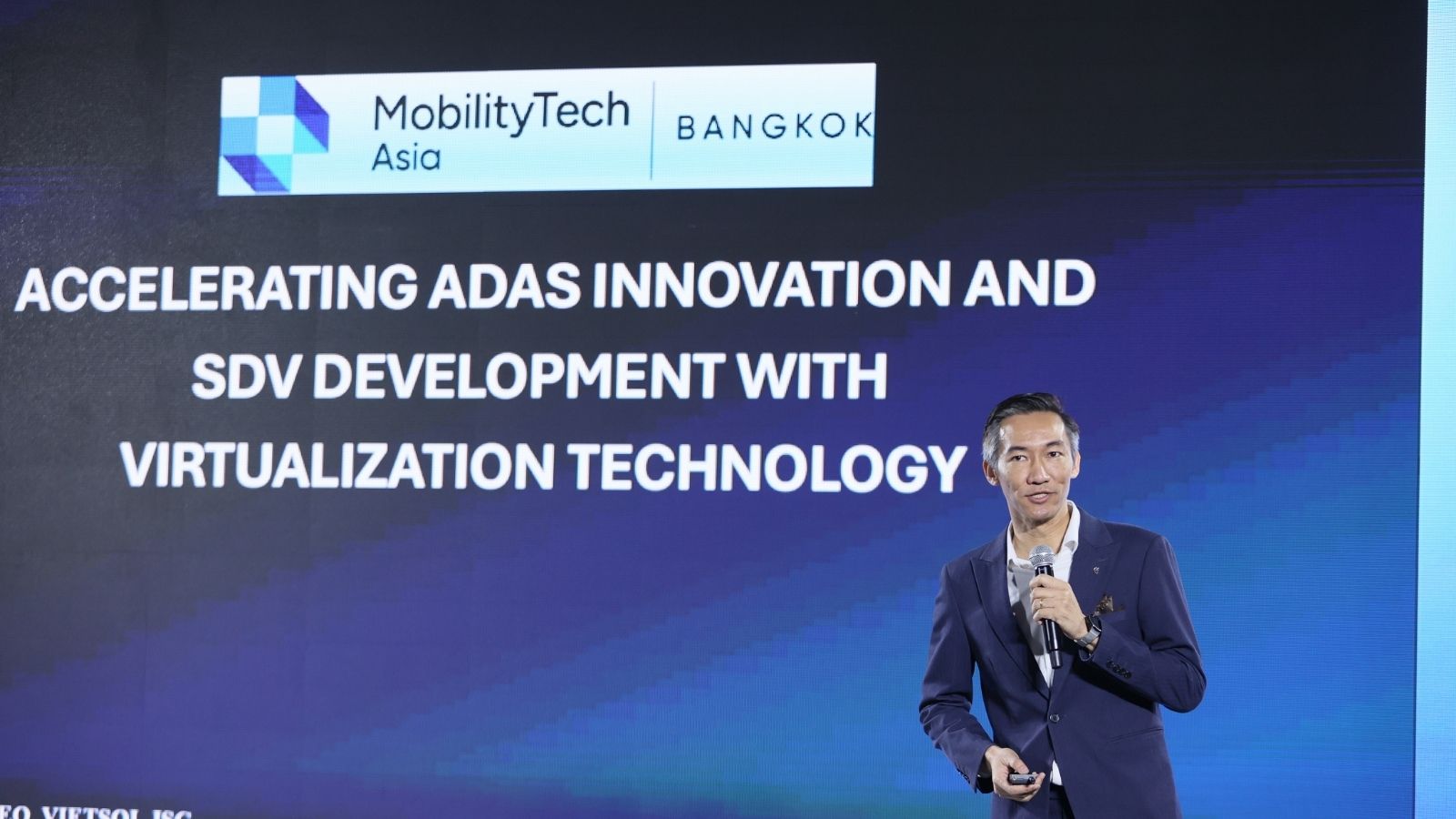
During his presentation, he highlighted a challenge faced by many OEMs and Tier-1 suppliers: while automotive software continues to evolve rapidly, many development processes remain constrained by hardware availability. As a result, hardware often dictates the pace of software development rather than enabling it.

This article summarizes the key insights from the presentation, explaining the growing importance of Virtualization in modern automotive software engineering and how Vietsol builds the technical capabilities to help OEMs and Tier-1 suppliers shorten the development cycle for ADAS and SDVs.
Why Is Virtualization Becoming Increasingly Important for ADAS and Software-Defined Vehicles (SDVs)?
What Is Virtualization?
Virtualization is a technology that enables the creation of virtual environments from a single physical machine, allowing for more efficient use of resources by distributing them across computing environments. In the automotive industry, this technology allows components such as ECUs, SoCs, sensors, and communication networks to be virtualized as software models, enabling development teams to verify system functionality and evaluate system behavior before deploying software onto physical hardware.
The rise of Software-Defined Vehicles (SDVs) has transformed Virtualization from a supporting technology into a core capability of modern automotive software development.
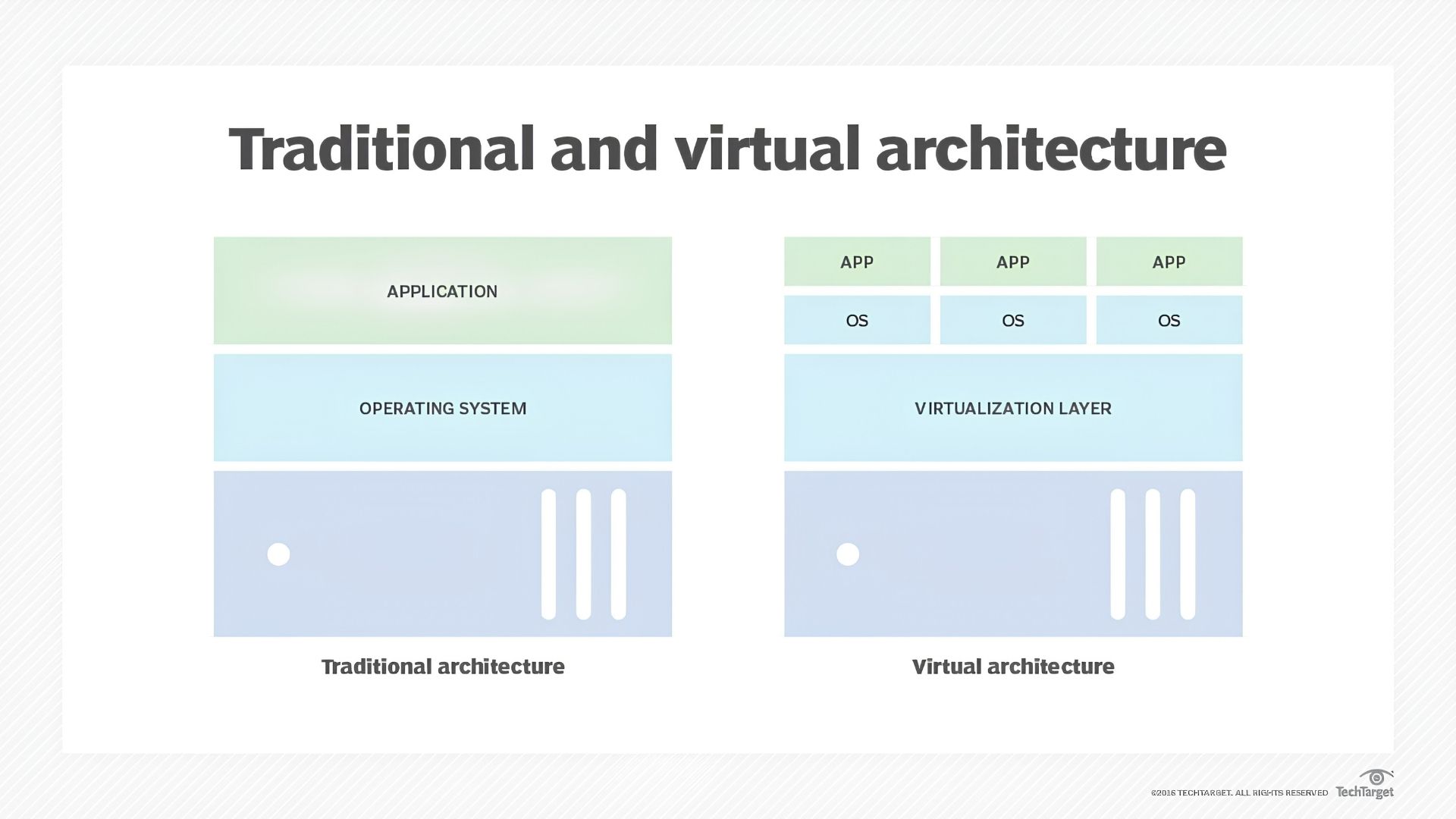
In traditional vehicle architectures, software is tightly coupled with individual ECUs. SDVs, however, adopt architectures based on Central Compute, Zonal ECUs, and Service-Oriented Architecture (SOA), allowing hardware and software to be decoupled so that vehicle functions can be continuously updated throughout the product lifecycle. This architectural shift enables software development, integration, and verification to proceed in parallel with hardware development instead of waiting until physical systems become available.
For ADAS, the importance of Virtualization is even greater. An ADAS system must simultaneously process data from multiple sensors, interact with numerous ECUs, and operate reliably under a wide range of driving conditions. Validating every possible scenario on physical vehicles is both costly and time-consuming, while reproducing identical traffic situations and operating conditions across repeated tests is often impractical.
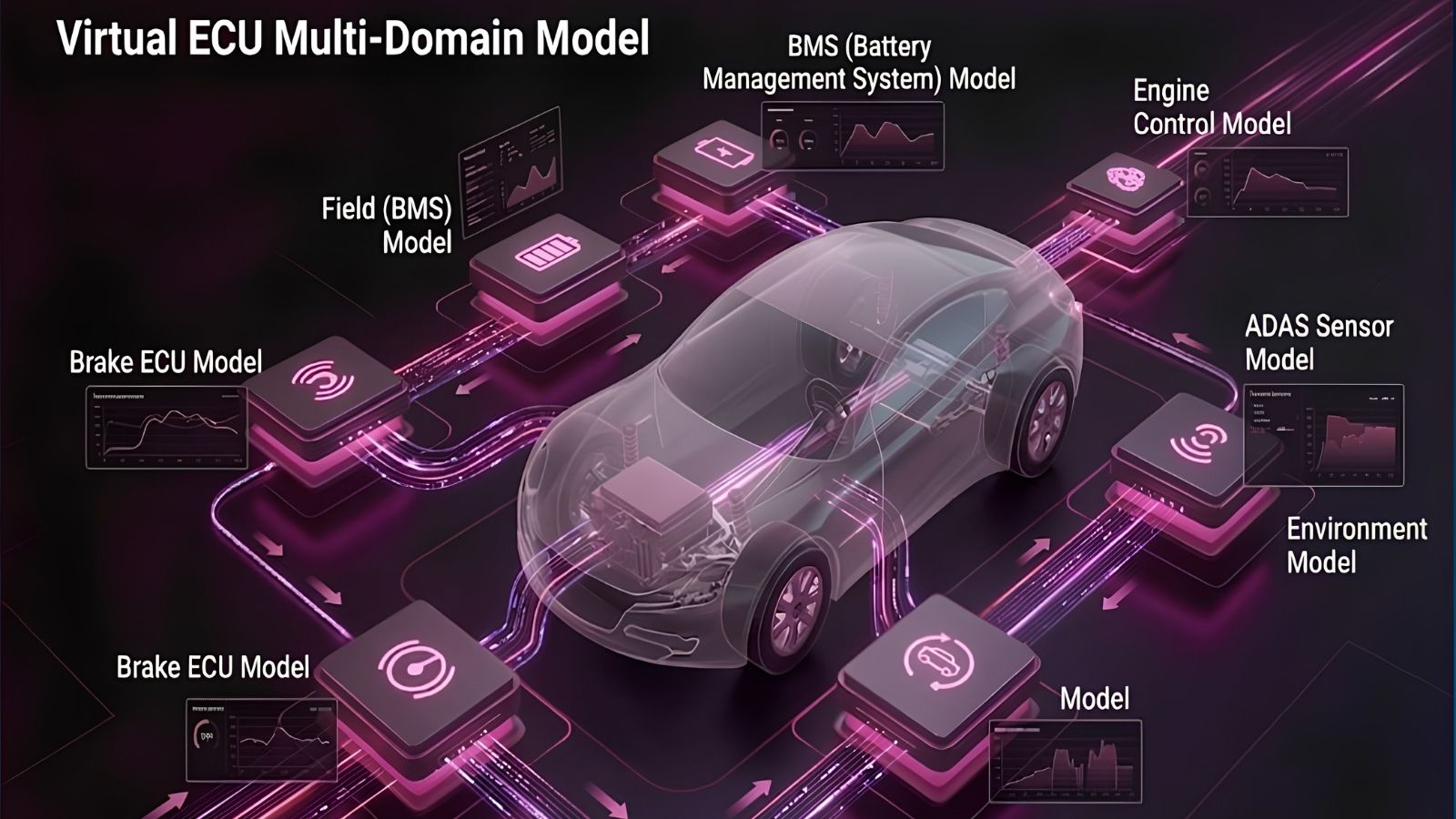
To overcome these limitations, Virtualization recreates the vehicle system within a digital environment using virtual ECUs (vECUs), sensor models, vehicle models, and simulation environments. This enables development teams to execute thousands of test scenarios with a high degree of automation and repeatability, providing OEMs with a more efficient way to accelerate ADAS development while expanding both test coverage and software quality.

Global Trends in Automotive Virtualization
The evolution of Software-Defined Vehicles (SDVs) is reshaping how OEMs develop and deliver automotive software. According to Dr. Herbert Diess, former CEO of Volkswagen AG, “Software will account for 90% of future innovations in the car “. This statement reflects a broader industry trend in which software has become a key differentiator for modern vehicles, driving everything from ADAS capabilities and connected services to over-the-air (OTA) updates. When software continues to grow in both scale and complexity, conventional development processes that rely heavily on physical prototypes are no longer sufficient to meet today’s requirements for development speed and scalability. This has made Virtualization an essential component of modern automotive software engineering.
The same trend is reflected in the SDV strategies of leading automotive technology companies. According to Elektrobit, Virtualization is no longer merely a testing aid but has evolved into a Software Architecture Enabler, providing the foundation for separating software from hardware and enabling applications to be developed independently of the underlying hardware architecture. Built on this foundation, Virtual Testing, Continuous Integration (CI), Continuous Testing (CT), and Continuous Deployment (CD) are becoming standard engineering practices in SDV development. Together, these practices enable engineering teams to integrate, verify, and release software more frequently while maintaining high software quality.
The Relationship Between Virtualization and Software-in-the-Loop (SiL)
Although Virtualization and Software-in-the-Loop (SiL) are often discussed together, they are not interchangeable concepts. Instead, they complement one another. Virtualization provides the digital environment that models the components of a vehicle system, while SiL leverages that environment to integrate, verify, and test automotive software before it is deployed onto physical hardware.
In a complete SiL environment, virtual ECUs, sensor models, vehicle models, simulation platforms, and simulation environments work together to replicate the behavior of real vehicle systems. This enables software to be validated under realistic operating conditions without relying on the production of ECUs or prototype vehicles. As a result, development teams can identify defects much earlier in the development lifecycle, expand test coverage, and automate regression testing before progressing to Hardware-in-the-Loop (HiL) validation or on-road vehicle testing.
SiL therefore serves as the bridge between software development and physical system validation, allowing most software defects to be identified within a virtual environment before entering significantly more expensive validation stages. More importantly, SiL represents the practical realization of Virtualization, enabling OEMs to implement shift-left verification strategies and establish software development processes suited to the Software-Defined Vehicle era.
Software-in-the-Loop: A Mature Validation Framework
What is Software-in-the-Loop?
Software-in-the-Loop (SiL) addresses these challenges by enabling engineers to test and validate compiled software in a virtual environment that mimics real-world behavior – before the hardware is even available. This allows engineers to verify software functionality, validate algorithms, and optimize system behavior early in the development lifecycle before deployment to production hardware.
How Software-in-the-Loop Achieves Effectiveness in a Testing Environment
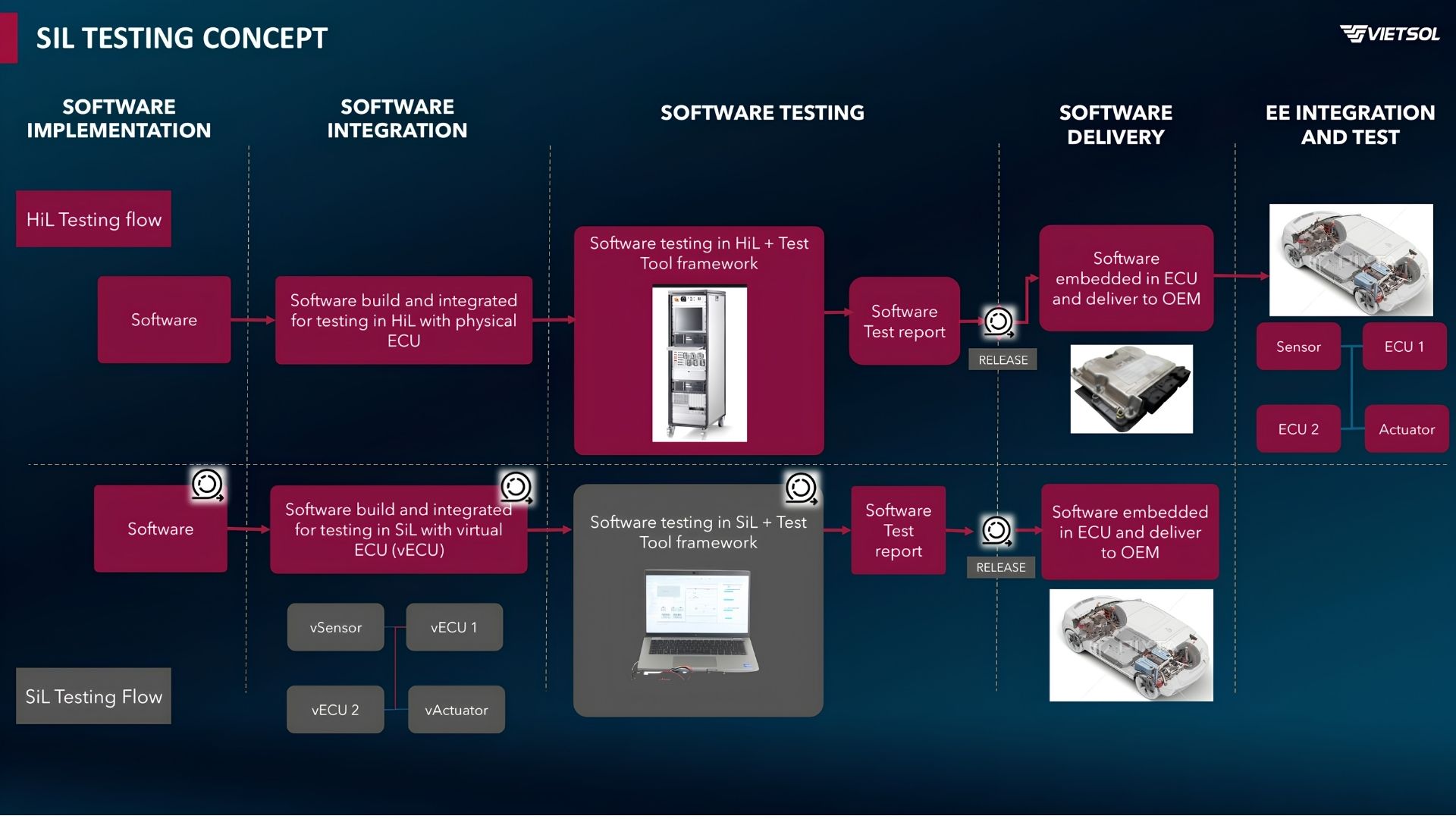
Software-in-the-Loop (SiL) is far more than simply running an ECU model on a computer. To fully realize its value in ADAS and Software-Defined Vehicle (SDV) development, organizations need more than a simulation environment—they require strong domain expertise, a robust technical platform, and well-established deployment processes. These three capabilities form the foundation of Vietsol’s approach to delivering SiL solutions for OEMs and Tier-1 suppliers.
An effective SiL platform should closely reflect how automotive software is developed and validated throughout an OEM program. Backed by extensive experience in embedded ECU software validation and direct involvement in OEM validation gates and quality processes, Vietsol’s engineering team can translate system requirements into SiL architectures and test scenarios tailored to the needs of individual vehicle programs, rather than relying on generic simulation models.
Beyond engineering expertise, Vietsol also develops customizable SiL frameworks by combining hands-on project experience with Vector’s development ecosystem and open standards such as OpenDRIVE and OpenSCENARIO. These frameworks support regression testing, integrate seamlessly into Continuous Integration (CI) and Continuous Testing (CT) workflows, and can be reused across multiple vehicle programs and ECU configurations, improving both development efficiency and scalability.
Another key advantage of SiL is its ability to move software validation much earlier in the development lifecycle, eliminating the need to wait for production hardware before verification can begin. Test environments can be deployed either on developers’ workstations or in cloud-based infrastructure, making it easier to scale testing activities, increase automation, and continuously maintain and enhance the SiL framework throughout the entire project lifecycle.
How Does Vietsol Implement Software-in-the-Loop for OEMs?
At Vietsol, Software-in-the-Loop (SiL) is treated as an engineering capability rather than a standalone testing solution. Its implementation follows a structured roadmap that combines expertise in ECU systems, an appropriate Virtualization platform, and deployment processes aligned with OEM development requirements.
This approach is designed to address two common challenges in modern automotive software programs. The first is standardization. A SiL environment must remain interoperable across different E/E architectures, vehicle platforms, and product variants without requiring significant redesign. The second is integration. Since a typical vehicle program incorporates ECUs, sensors, and actuators supplied by multiple vendors, the underlying SiL infrastructure must be flexible enough to integrate these heterogeneous components, validate them within a common environment, and support reuse across multiple vehicle programs. When designed correctly from the outset, the platform can be developed once and continuously maintained and extended, eliminating the need to rebuild the entire environment for every new project.
To achieve this, Vietsol follows a four-stage implementation roadmap.
- The first stage focuses on a SiL-first strategy, helping OEMs identify suitable use cases while defining software development plans and test strategies around a SiL-based workflow.
- The second stage establishes the SiL implementation strategy by deriving technical requirements from each use case, defining Virtual ECU (vECU) requirements for individual ECU suppliers, and coordinating the development of the required vECUs.
- In the third stage, the developed vECUs are integrated into the OEM’s SiL framework together with components from multiple suppliers, enabling system-level integration and validation within a unified simulation environment.
- The final stage prepares the SiL environment for production use by aligning it with ISO 26262 requirements, integrating it into the OEM’s existing software development process, and enabling large-scale testing, validation, and automation.
How Is Software-in-the-Loop (SiL) Deployed on a Virtualization Platform?
Software-in-the-Loop (SiL) can only deliver its full value when built upon a comprehensive Virtualization platform, where the technology infrastructure, development toolchain, engineering processes, and technical expertise work together seamlessly. This integrated approach enables OEMs and Tier-1 suppliers to shorten software development cycles, expand testing capabilities, and support Continuous Integration (CI), Continuous Testing (CT), and Continuous Deployment (CD) throughout ADAS and Software-Defined Vehicle (SDV) development.
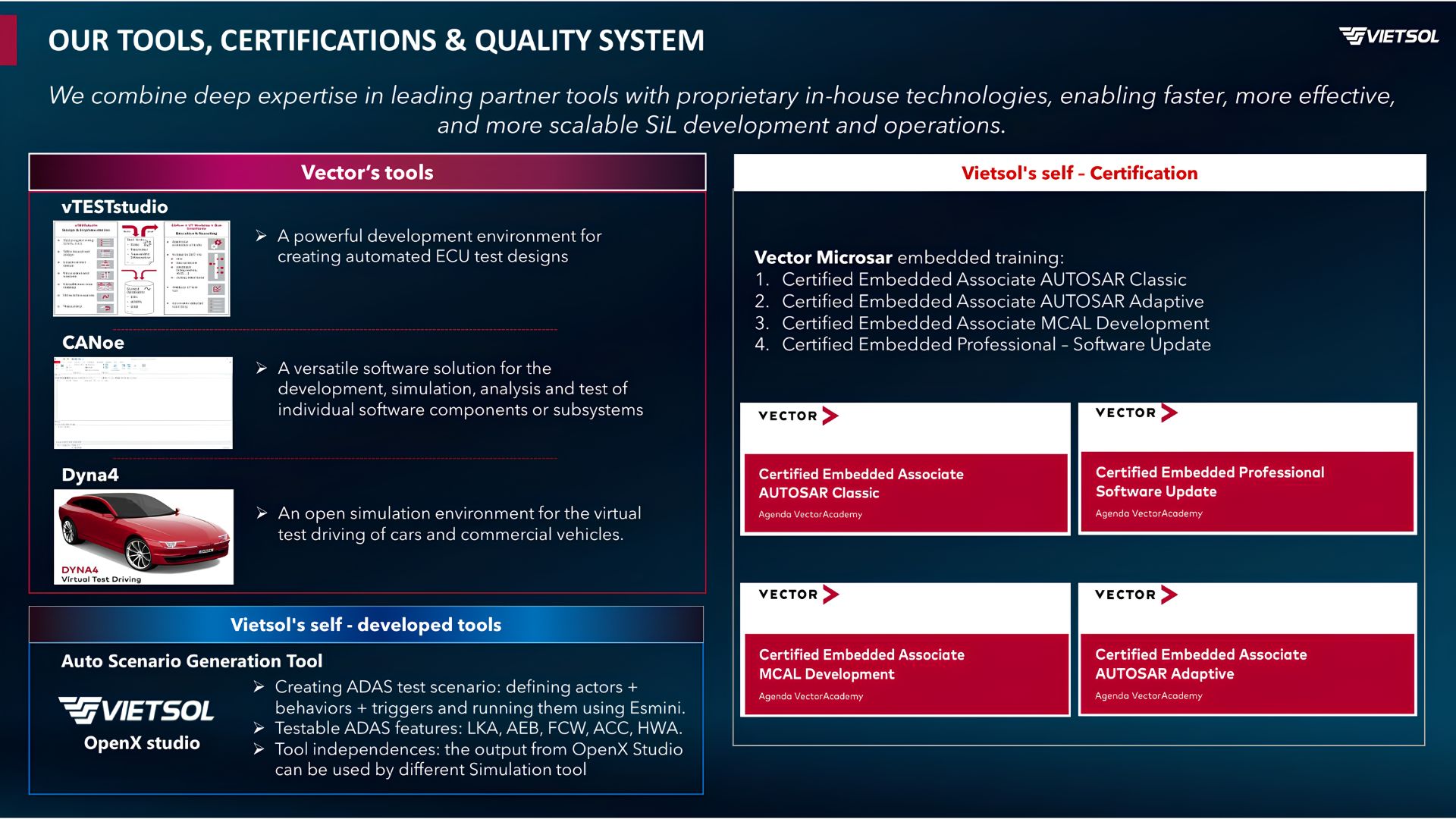
To achieve this, Vietsol has built our Virtualization ecosystem around three core pillars: tools, engineering capabilities, and people. As Vector’s Technical Partner in Southeast Asia, Vietsol leverages Vector’s development ecosystem across software development, integration, and validation programs while complementing it with in-house tools tailored to the specific requirements of individual OEMs and Tier-1 suppliers.
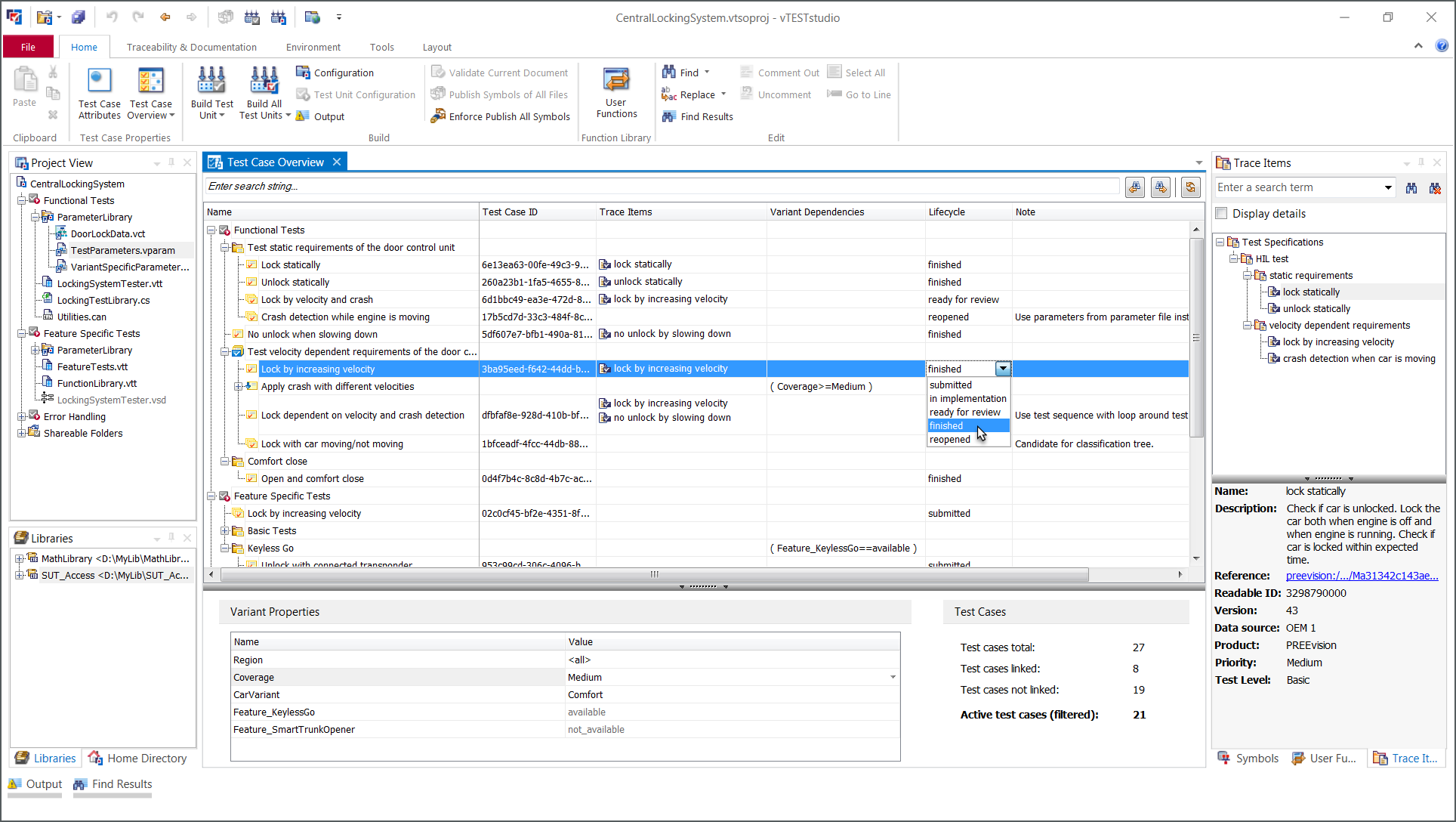
Tool ecosystem supporting Virtualization deployment:
|
Tool |
Category | Core Function |
Typical Applications |
| CANoe | Core platform | ECU and subsystem development, simulation, analysis, and testing | SiL environments, multi-ECU integration, CI/CT workflows for OEMs and Tier-1 suppliers |
| vTESTstudio | Built on CANoe | Automated ECU test case design and management | Single-ECU and multi-ECU testing, reduced test setup time, improved test case management |
| Dyna4 | Built on CANoe | Vehicle dynamics and virtual driving environment simulation | Closed-loop testing for ADAS, chassis, and powertrain systems in passenger and commercial vehicles |
| OpenX Studio | In-house development | Automated ADAS scenario generation using actors, behaviors, and triggers, executed through Esmini | Validation of LKA, AEB, FCW, ACC, and HWA, with portable outputs across multiple simulation platforms |
Among these tools, OpenX Studio – Auto Scenario Generation Tool is developed in-house by Vietsol to address customer-specific requirements and enhance the efficiency of Virtualization environments. The tool enables engineers to generate ADAS test scenarios more efficiently, reducing environment setup time, improving test case reusability, and supporting deployment across multiple simulation platforms. This in-house development capability also allows Vietsol to tailor Virtualization environments to project-specific requirements instead of relying solely on a single commercial tool ecosystem.
In addition, Vietsol’s engineering team is professionally trained through Vector’s advanced programs and holds certifications in AUTOSAR Classic, AUTOSAR Adaptive, MCAL Development, and Software Update. This technical foundation enables the team to follow modern automotive software development processes while delivering ADAS and Software-Defined Vehicle (SDV) projects in accordance with the rigorous engineering requirements of global OEMs.
In recent years, Vietsol has actively participated in international automotive and technology forums alongside OEMs, Tier-1 suppliers, and leading technology partners. Company representatives have contributed as Technical Partners, Knowledge Partners, and speakers, sharing expertise across a wide range of automotive software topics. These engagements reflect Vietsol’s ongoing involvement in global technical exchange and innovation initiatives within the automotive industry.
Deploy Virtualization for ADAS and SDV with Vietsol
Software-Defined Vehicles are redefining how automotive software is developed and validated. Meeting these new demands requires more than advanced technology, it calls for a partner with proven implementation capabilities, a deep understanding of OEM development processes, and the ability to translate engineering requirements into practical solutions. With extensive experience in ADAS, Virtualization, and Software-in-the-Loop (SiL), Vietsol supports OEMs and Tier-1 suppliers throughout the entire development journey – from solution consulting and development environment setup to validation workflow implementation tailored to each vehicle program.
For more information or to discuss a solution tailored to your organization’s needs, contact Vietsol’s engineering team.
RELATED NEWS
What is Fleet Management System? Components, Features, and Benefits
A Fleet Management System brings data from multiple sources together on a single platform, enabling businesses in the transportation and passenger transport sectors to monitor, analyze, and manage their fleet operations more effectively and comprehensively. Fleet management requires businesses to monitor vehicles, drivers, and a wide range of operational data...
Vietsol Wins Pizza Pitching, Advances to Top 20 of Next Wave of Startups 2026
Vietsol was named the sole winner of the Pizza Pitching session at the Ecosystem Meetup held in Ho Chi Minh City on September 19, securing a place in the Top 20 of the Next Wave of Startups 2026 Accelerator Program. The Ecosystem Meetup marked the opening of Next Wave of...
Safe Following Distance on Highway: Regulations and Practical Challenges
Safe following distance on highway is regulated based on vehicle speed, with minimum distances ranging from 35 m to 100 m. However, at high speeds, accurately estimating the distance between vehicles can be challenging. Starting August 27, 2026, the Traffic Police began taking action against violations of highway safety distance...