
 Tiếng Việt
 日本語
日本語
For decades, artificial intelligence lived in data centers, powerful, but distant. Every decision required a round trip to the cloud: data sent up, results sent back, action taken. That model worked well enough when speed was optional. Today, it often isn’t.
Edge AI changes the equation by bringing intelligence directly to the device. Whether it’s a camera on a factory floor, a sensor on a patient’s wrist, or a chip inside a moving vehicle, the ability to process data locally, instantly, privately, and reliably, is redefining what AI can do in the real world.
This article explores what Edge AI is, why it matters, and how it is already being put to work across industries.
What Is Edge AI? A Deep Dive into the Technology Behind the Trend
What Is Edge AI?
Edge AI refers to the deployment of artificial intelligence directly on local devices – such as cameras, sensors, smartphones, and industrial equipment – rather than relying on centralized cloud servers for data processing. By bringing computation to the point where data is generated, Edge AI enables devices to analyze information, draw insights, and act in real time, without the need to transmit data back and forth to a remote server.
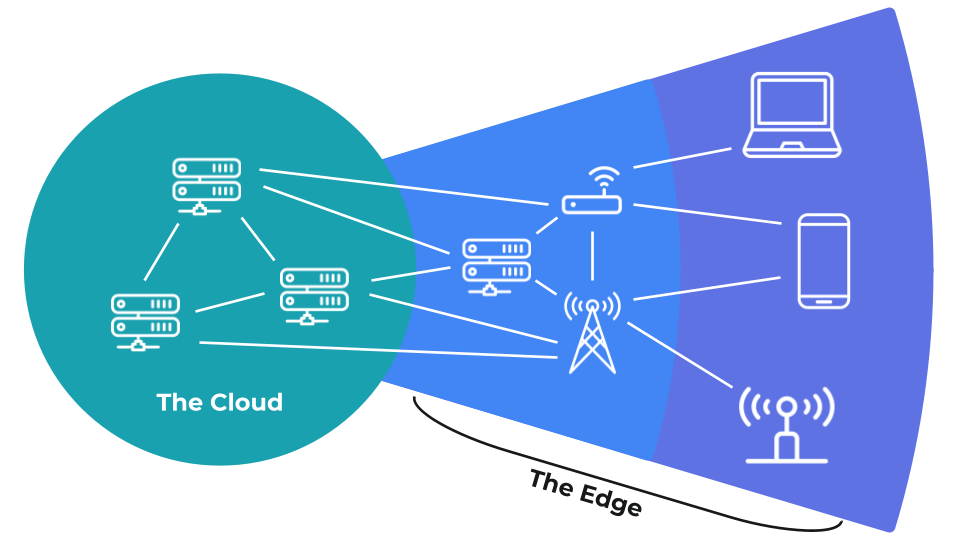
Key Benefits of Edge AI
Edge AI delivers a distinct set of advantages that make it increasingly compelling for organizations seeking faster, safer, and more efficient AI deployments. Three core benefits stand out:
- Real-time data processing at the edge: Traditional cloud-based AI models require sending data to the cloud for processing, which can introduce latency. Edge AI processes data locally to speed up response time and enable real-time decision-making. This is particularly beneficial in applications such as autonomous vehicles, industrial automation, and smart cities, where instant data processing is critical. Edge AI can reduce latency in decision making and increase speed.
- Enhanced privacy and security: Processing data locally on edge devices instead of sending it to the cloud can reduce data privacy concerns. By keeping sensitive information within the local network, edge AI ensures data remains secure and confidential.
- Reduced reliance on cloud resources: Reduce reliance on cloud resources and continuous cloud connectivity. This minimizes bandwidth requirements and lowers operational costs.
How It Works
Edge AI works by embedding AI algorithms directly into edge devices, enabling them to analyze data, recognize patterns, and make decisions on-site – without relying on a cloud connection for every operation. This is made possible through a combination of specialized hardware, optimized software frameworks, and AI models specifically designed for resource-constrained environments.
On the hardware side, modern edge devices are equipped with dedicated accelerators such as neural processing units (NPUs), digital signal processors (DSPs), and AI-enhanced microcontrollers. These components are engineered to execute AI workloads efficiently at low power consumption, making them well-suited for energy-sensitive applications like wearable health monitors, remote sensors, and embedded industrial systems. To ensure AI models run effectively within these hardware constraints, developers apply a set of model optimization techniques – including sparsity, which reduces unnecessary parameters; model pruning, which removes redundant or low-impact connections; and quantization, which converts model weights into lower-precision formats to improve processing speed without significantly compromising accuracy.
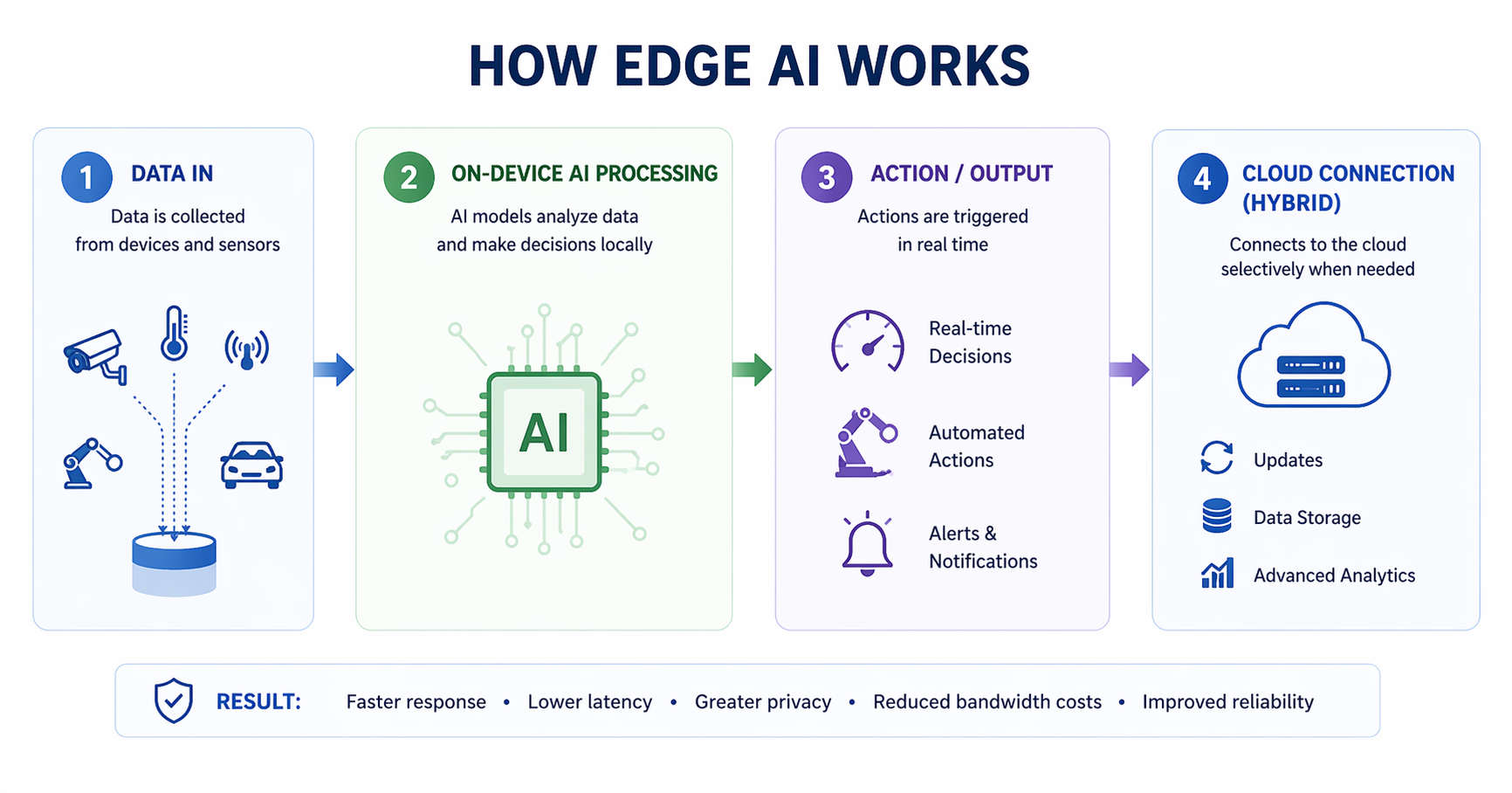
On the software side, lightweight frameworks such as TensorFlow Lite, ONNX Runtime, and OpenVINO allow developers to deploy sophisticated AI models across a wide range of devices, from smartphones to industrial machinery. Real-time operating systems and middleware further support reliable task management, ensuring that AI-powered features perform consistently even under demanding operational conditions.
Despite its emphasis on local processing, Edge AI is not entirely disconnected from the cloud. Most edge devices maintain a hybrid connectivity model, communicating with the cloud selectively for tasks such as software updates, long-term data storage, or computationally intensive analytics. This balanced approach allows edge devices to stay current and secure while continuing to deliver the low-latency, real-time intelligence that defines the technology.
Edge AI Use Cases by Industry
Edge AI is already transforming how industries operate, from cutting costs and automating decisions to improving safety and customer experience. Below are some of the most prominent applications across key sectors.
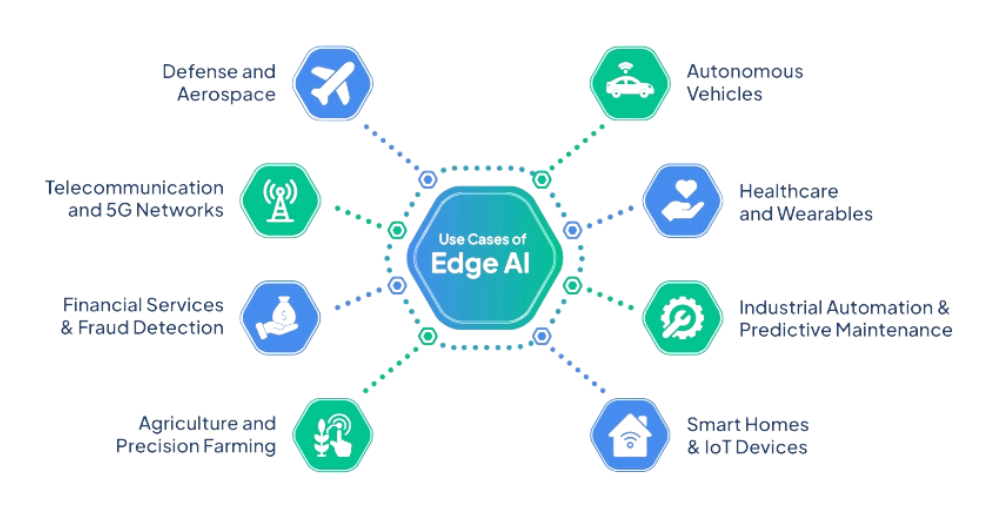
Healthcare & Wearables
Wearable devices equipped with Edge AI can monitor vital signs such as heart rate, blood pressure, and glucose levels in real time, and instantly alert caregivers in emergency situations. In pre-hospital care, ambulances leveraging Edge AI allow paramedics to process patient data on the go and coordinate with physicians before arrival, enabling faster and more effective treatment.
Industrial Automation
Supports predictive maintenance and defect detection, improving efficiency and reducing downtime in production lines. AI analyzes sensor data to detect early signs of failure. This allows proactive intervention before costly breakdowns occur.
Agriculture
Uses AI sensors and drones to monitor crops, optimize irrigation, and track livestock health for more efficient farming. Data is processed on-site for immediate insights. This helps farmers make faster, more accurate decisions in changing conditions.
Smart Homes & IoT
Detects fraud in real time at ATMs and POS systems, while enabling instant decision-making in trading and customer service. AI models analyze transaction patterns locally. This reduces risk and improves response speed in critical financial operations.
Financial Services
Edge AI brings computer vision and object detection directly to smart security devices, enabling them to identify suspicious activity and trigger alerts in real time – without the latency introduced by cloud-based processing systems.
Telecom & 5G
Optimizes network performance, predicts bandwidth demand, and enhances security through real-time data processing. Edge AI allows faster handling of network traffic. This leads to improved service quality and reduced latency for users.
Defense & Aerospace
Supports real-time surveillance, battlefield decision-making, and satellite data analysis for critical operations. AI processes data directly from sensors and imaging systems. This ensures faster, more reliable responses in high-stakes scenarios.
Vietsol: Where Edge AI Meets Real-World Complexity
These applications are no longer theoretical. Across Southeast Asia, companies are already putting Edge AI to work in precisely these ways.
Vietsol is not just exploring possibilities – it is actively developing and deploying real-world Edge AI projects with enterprise clients across the region. From production lines and connected vehicles to intelligent urban systems, these implementations demonstrate proven use of cases already operating in live environments. This hands-on experience positions Vietsol as an early mover, helping pioneer how Edge AI is applied at scale in Southeast Asia.
Here are a few examples of how Vietsol is bringing Edge AI into practice.
Manufacturing Quality Inspection & Automation
Vietsol has deployed an automated 360° inspection system for metal components, using a three-camera array (Top, Side, Inner) that processes up to 18 images per product cycle – all running directly on the Jetson Orin NX chip. Results achieved include accuracy above 95%, a zero missed-defect rate, and inference times of just 15-40ms. In garment manufacturing, the system detects color and pattern defects within 70ms; for shoe soles, AI measures curvature and verifies embossed information with 99.2% accuracy.
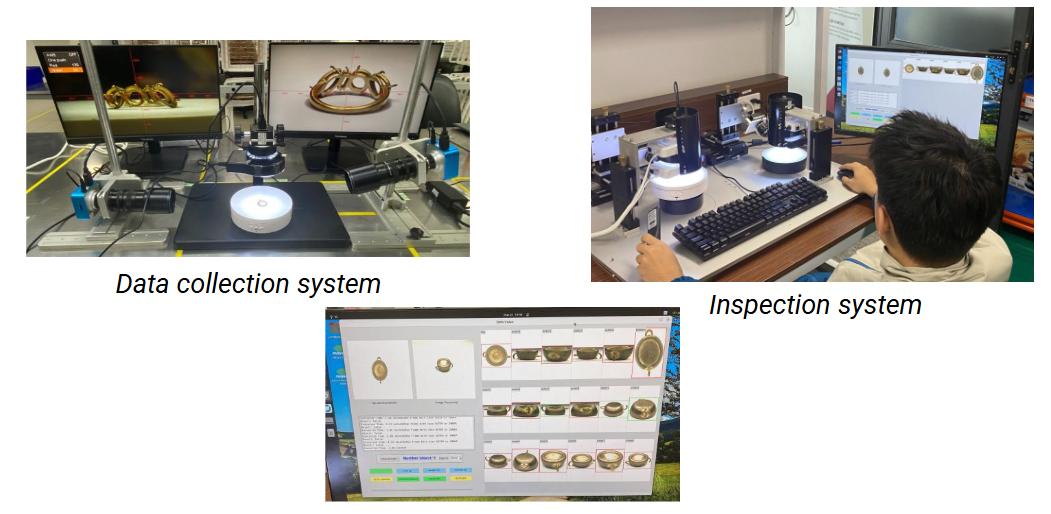
But detection alone is not enough. Rather than simply alerting human operators, Vietsol’s AI system monitors, evaluates, and responds directly to the production line in real time – automatically optimizing assembly processes and work allocation without operator intervention. The result is a fully closed loop: the system sees a problem, decides, and acts on it.
Predictive Maintenance
Vietsol’s Smart AIoT device integrates four types of sensors directly onto machinery: vibration (ISM330DLC), temperature (HTS221), sound (LPS22HB), and current (ACS712). Signals are processed on-device – converted from the time domain to the frequency domain, extracting features such as RMS, kurtosis, and peak magnitude – to detect anomalies before they become failures. The entire process bypasses the cloud, ensuring immediate response even when the factory loses its internet connection.
Automotive Solutions
Vietsol’s automotive suite covers two distinct product lines.
- Under ADAS, the lineup includes Auto Parking Assist and a Motorcycle ADAS system – extending safety features to two-wheeled vehicles, a critical and often overlooked segment in Southeast Asia.
- Under Smart Cockpit, the Driver Monitoring System (DMS) and Occupant Monitoring System (OMS) analyze driver behavior in real time, detecting drowsiness, distraction, and emotional state. All products comply with ISO 26262 (functional safety) and ISO/SAE 21434 (cybersecurity).
Smart Buildings and Cities
Vietsol’s Edge AI devices collect data from motion, CO₂, temperature, and lighting sensors to automatically adjust HVAC and lighting – without routing through the cloud. Measured results show energy savings of 20-40%, equivalent to USD 120,000-220,000 per year for a 10,000m² building. Additionally, an Automatic License Plate Recognition (ALPR) system and intelligent traffic management solution optimize signal timing based on real-time data – replacing outdated fixed schedules.
Conclusion
Vietsol delivers end-to-end Edge AI solutions designed to operate reliably in complex, real-world environments. Its portfolio spans intelligent vision systems, AIoT devices, and automotive-grade platforms – all engineered for low-latency processing, high accuracy, and energy-efficient performance at the edge. By combining optimized hardware integration with advanced AI models, Vietsol enables seamless deployment across a wide range of applications, from manufacturing and mobility to smart infrastructure.
Whether deploying automated inspection systems, predictive maintenance solutions, or in-vehicle intelligence, Vietsol provides the foundational capabilities needed to accelerate implementation and meet the stringent requirements of edge environments. Its Edge AI solutions empower organizations to build secure, scalable, and responsive systems that transform real-time data into immediate action – helping businesses stay competitive in an increasingly intelligent and connected world.
To learn more about how Vietsol’s Edge AI solutions can be applied to your industry, contact us today!
Frequently asked questions
1. What is the difference between Edge AI and Cloud AI?
The key difference lies in where data is processed. Traditional cloud AI relies on centralized data centers, meaning data must be sent to the cloud for analysis – introducing latency, higher bandwidth usage, and potential security risks during transmission.
Edge AI, in contrast, processes data directly on the device. This enables real-time decision-making, reduces reliance on internet connectivity, and enhances data privacy. As a result, Edge AI is better suited for time-sensitive and context-aware applications such as autonomous vehicles and healthcare monitoring, where instant response is critical.
| Feature | Edge AI | Traditional Cloud AI |
| Processing Location | On device | Remote data centers |
| Latency | Real-time, low latency | Higher latency due to data round trips |
| Bandwidth Use | Minimal (only essential data sent) | Heavy (transmits full raw data) |
| Privacy | Data stays on device | Data is exposed during transmission |
| Context Awareness | High (localized, real-time decisions) | Limited (centralized understanding) |
| Reliability | Works offline or with poor connectivity | Requires stable network connection |
2. What are the hardware requirements for deploying Edge AI?
Deploying Edge AI requires a combination of AI-capable hardware and optimized system resources, depending on the complexity of the use case. At the core are processors designed for AI workloads, such as GPUs, TPUs, NPUs, or edge-optimized CPUs, which enable efficient on-device inference.
In addition, edge devices or IoT gateways must have sufficient compute capacity, along with adequate memory and storage – typically at least 4GB of RAM and fast storage like SSD or NVMe – to handle data processing locally. Reliable connectivity (such as 5G, Wi-Fi, or Ethernet) is also important for tasks like system monitoring, updates, or hybrid cloud integration.
Ultimately, the exact hardware requirements vary based on factors such as model size, latency requirements, and the specific application, ranging from lightweight sensors to more powerful industrial edge servers.
3. What industries can benefit from Edge AI?
Almost every industry can benefit from Edge AI, including manufacturing, healthcare, retail, maritime, agriculture, and logistics, as it enables real-time data processing and automation directly at the source without relying heavily on the cloud.
References
- What is Edge AI? – How it Works | Synopsys
- What Is Edge AI? | IBM
- What is Edge Computing in AI? – Cisco
- Optimizing AI Models for Edge Devices: The Ultimate Guide
- Introduction to edge AI – Edge Impulse Documentation
RELATED NEWS
Vietsol and KPIT Sign MoU to Expand Automotive Engineering Delivery for OEMs Across Southeast Asia
Hanoi, Vietnam, August 20, 2026 – Vietsol and KPIT Technologies signed a Memorandum of Understanding (MOU) to collaborate on advanced mobility software and engineering services for OEMs and Tier-1 suppliers across Southeast Asia. Vietsol is a Vietnam-based engineering company specializing in automotive, mobility, and advanced manufacturing technology; KPIT Technologies is...
Vietsol and Datakrew Sign MoU to Advance EV Fleet and Battery Intelligence for Automotive OEMs
The collaboration combines Datakrew’s mobility intelligence technology with Vietsol’s automotive engineering expertise, system integration capability, and local execution strength to support an initial OEM opportunity in Vietnam, while also laying the groundwork for broader cooperation in EV and software-defined vehicle (SDV) development. Hanoi, Vietnam, July 2026 — Vietsol Joint Stock...
Vietsol at MTA Vietnam 2026: Bringing Edge AI into Real Manufacturing Challenges
At MTA Vietnam 2026, one of Vietnam’s leading international exhibitions for precision engineering and manufacturing, Vietsol presented a range of Edge AI applications to hundreds of domestic and international brands. Vietsol Edge AI, a business unit of Vietsol Joint Stock Company, joined the exhibition for the first time as a...