
 Tiếng Việt
 日本語
日本語
Learn what’s new in Euro NCAP 2026, from driver engagement scoring to real-time child detection, and what it means for OEMs and smart mobility.
From Collision Protection to Driver Engagement: A Shift in Safety Thinking
Vehicle safety used to mean surviving from a crash (passive safety). Today, it extends to entire crash avoidance (active safety). The Euro NCAP 2026 roadmap marks a decisive pivot in how we evaluate safety, expanding beyond crumple zones and airbags to include in-cabin awareness, driver attention, and real-time response capabilities.
This paradigm shift reinforces the importance of Driver Monitoring Systems (DMS) and Occupant Monitoring Systems (OMS) in meeting stricter, software-driven safety requirements. For OEMs, this transition demands a cohesive software and systems engineering strategy, one that can scale fast and integrate smart.
What’s New in Euro NCAP 2026?
The latest Euro NCAP 2026 protocols (see official source) bring sweeping updates across three core categories:
| Criteria | 2023 Protocol | 2026 Protocol |
| Driver Monitoring (DMS) | Up to 2 points, basic drowsiness and distraction alerts | Up to 25 points, requires real-time eye and head tracking in new “Driver Engagement” category |
| Impairment Detection | Not included | DMS must detect signs of alcohol or drug impairment |
| Unresponsive Driver | Alerts issued, limited intervention | Must escalate warnings and activate emergency stop if necessary |
| Child Presence Detection (CPD) | Up to 4 points for basic presence detection | Up to 5 points, requires direct sensing, escalating alerts, and intervention (e.g., climate control) |
| Seatbelt Monitoring | Detects whether belts are buckled | Must detect incorrect wear (e.g., behind back) and monitor rear seats |
| Airbag Adaptation | No specific occupant-based requirements | Airbags must adjust to size and position, automatic deactivation for child seats mandatory |
Each of these new test items reflects not only a growing concern for human factors, but also a need for deeper system intelligence, real-time inference, and software traceability.
Elevating DMS from Optional to Essential
The biggest shift lies in how Driver Monitoring Systems are evaluated.
Where previous assessments only checked for drowsiness, Euro NCAP 2026 adds:
- Track real-time eye and head movement to verify engagement
- Drowsiness monitoring must be operational at speeds of 50 km/h or higher
- Including frequent short glances away in distraction monitoring
- Phone usage recognition, not just general inattention
- Impairment detection (due to alcohol, drugs)
- Response for unresponsive drivers with escalating warnings and automated interventions
These new standards essentially move DMS from being a comfort feature to a safety-critical requirement.
Vietsol’s DMS/OMS platform leverages camera-based analytics and AI to assess driver gaze, attention levels, and micro-expression changes, ensuring compliance with Euro NCAP, UNECE, and ADAS safety stack integration.

Integrated Software: The Backbone of Standardized DMS
As DMS and OMS become mandatory, so does the complexity of software integration. The real challenge is not just detection, but connecting that detection to actuators, ADAS systems, and cloud infrastructure in a traceable, testable, and certifiable manner.
That’s where integrated software platforms come in.
Whether it’s synchronizing gaze tracking with steering assistance or triggering emergency stop protocols via DMS alerts, a well-integrated software architecture enables seamless safety execution.
Combined with Software-in-the-Loop (SiL) testing and Model-Based Systems Engineering (MBSE), engineers can now:
- Simulate DMS behavior across edge cases
- Test fail-safe logic under real-time conditions
- Ensure full traceability from system model to test reports
This drastically reduces integration errors while shortening certification timeframes.
Child Presence Detection and the Tech It Demands
One of the most emotionally charged features added to Euro NCAP 2026 is Child Presence Detection (CPD), now required for all new vehicles in the EU.

happy asian family on mini van are smiling and driving for travel on vacation. happy family with spending time outdoor.
CPD requires:
- Real-time occupant sensing (e.g. radar, thermal, ultrasonic, vision,…)
- Audio and haptic alert integration
- Cloud alerts to connected devices
These features demand not just hardware, but high-fidelity in-cabin perception software, areas where software partners can make a real difference.
Smarter Seatbelts and Adaptive Airbags
Euro NCAP 2026 introduces smarter requirements for restraint systems, including:
- Seatbelt misuse detection, including belts worn improperly
- Rear seat occupancy monitoring
- Adaptive restraint systems based on passenger size, posture, and position
- Automatic deactivation of front airbags when a rear-facing child seat is detected (manual switches won’t earn full points)
This pushes for advancements in occupant classification, 3D vision, and edge inference engines that personalize safety systems in real time.
What This Means for Tier 1s, OEMs, and Software Providers
For Tier 1s and OEMs, Euro NCAP 2026 is both a challenge and an opportunity:
- New requirements mean more system complexity
- But early adopters of integrated software and DMS/OMS platforms will lead
For software providers, this is the moment to demonstrate:
- AI-driven in-cabin perception
- Edge deployment efficiency
- Compliance-readiness for Euro NCAP
Looking Ahead, How Vietsol Helps You Stay Ready for Euro NCAP 2026
At Vietsol, we are actively supporting Tier 1 and OEM clients across Southeast Asia to get ahead of these changes. While client details remain confidential, Vietsol is already deploying DMS/OMS solutions in pre-production automotive programs throughout the region.
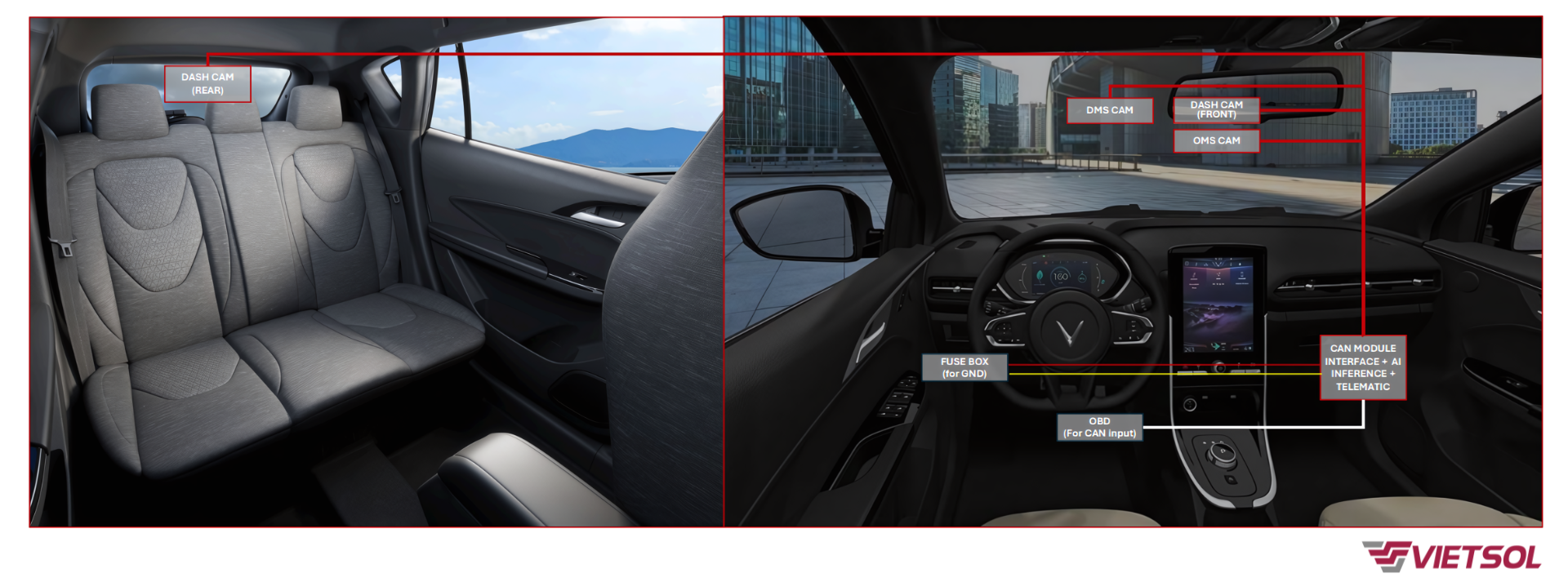
As a software-first partner with experience in SiL test frameworks, ADAS stack integration, and MBSE methodology, we help our partners:
- Develop AI-powered DMS/OMS systems
- Integrate with adaptive restraint logic and ECUs
- Validate via model-in-the-loop and SiL simulations
Whether you’re reworking your software validation roadmap or building DMS from the ground up, we’re ready to collaborate.
FAQs: Expanding the Euro NCAP and In-Cabin Safety Landscape
- What is Euro NCAP and why is it important?
Euro NCAP (European New Car Assessment Program) is an independent body that evaluates vehicle safety. Its 2026 update introduces new in-cabin safety standards, making software performance critical.
- What is a Driver Monitoring System (DMS)?
The Driver Monitoring System (DMS) is a system that supports monitoring the driver’s behavior and physical state in real-time. By utilizing a driver-facing camera combined with an Edge AI device, DMS can monitor and recognize any signs of distraction or other risky behavior from the driver. When potential risks are detected, the system issues immediate alerts, prompting the driver to take corrective action and thereby reducing the likelihood of accidents. Learn more in our dedicated blog post on DMS/OMS.
- How is Occupant Monitoring System (OMS) different from DMS?
OMS focuses on other occupants in the vehicle, especially children, detecting presence, posture, seatbelt usage and alertness, complementing DMS for full in-cabin awareness.
Learn more about the differences between DMS and OMS here.
- How does SiL testing support Euro NCAP 2026 readiness?
SiL (Software-in-the-Loop) enables testing software logic in simulated environments, allowing earlier validation of features like DMS and CPD under real-time conditions.
- How can Vietsol support Euro NCAP compliance?
We provide end-to-end DMS/OMS solutions, software integration services, and simulation frameworks tailored for safety validation and standards like Euro NCAP, ISO 26262, and UNECE.
RELATED NEWS
Vietsol and KPIT Sign MoU to Expand Automotive Engineering Delivery for OEMs Across Southeast Asia
Hanoi, Vietnam, August 20, 2026 – Vietsol and KPIT Technologies signed a Memorandum of Understanding (MOU) to collaborate on advanced mobility software and engineering services for OEMs and Tier-1 suppliers across Southeast Asia. Vietsol is a Vietnam-based engineering company specializing in automotive, mobility, and advanced manufacturing technology; KPIT Technologies is...
Vietsol and Datakrew Sign MoU to Advance EV Fleet and Battery Intelligence for Automotive OEMs
The collaboration combines Datakrew’s mobility intelligence technology with Vietsol’s automotive engineering expertise, system integration capability, and local execution strength to support an initial OEM opportunity in Vietnam, while also laying the groundwork for broader cooperation in EV and software-defined vehicle (SDV) development. Hanoi, Vietnam, July 2026 — Vietsol Joint Stock...
Vietsol at MTA Vietnam 2026: Bringing Edge AI into Real Manufacturing Challenges
At MTA Vietnam 2026, one of Vietnam’s leading international exhibitions for precision engineering and manufacturing, Vietsol presented a range of Edge AI applications to hundreds of domestic and international brands. Vietsol Edge AI, a business unit of Vietsol Joint Stock Company, joined the exhibition for the first time as a...