
 Tiếng Việt
 日本語
日本語
Edge AI took center stage at Automechanika Kuala Lumpur 2025, where Vietsol, one of Vietnam’s rising technology leaders, showcased its vision for smart manufacturing and mobility transformation. Held from May 15–17, the event brought together global automotive innovators, OEMs, and digital pioneers — and Vietsol made a powerful impression through thought leadership on Edge AI and Future Mobility.
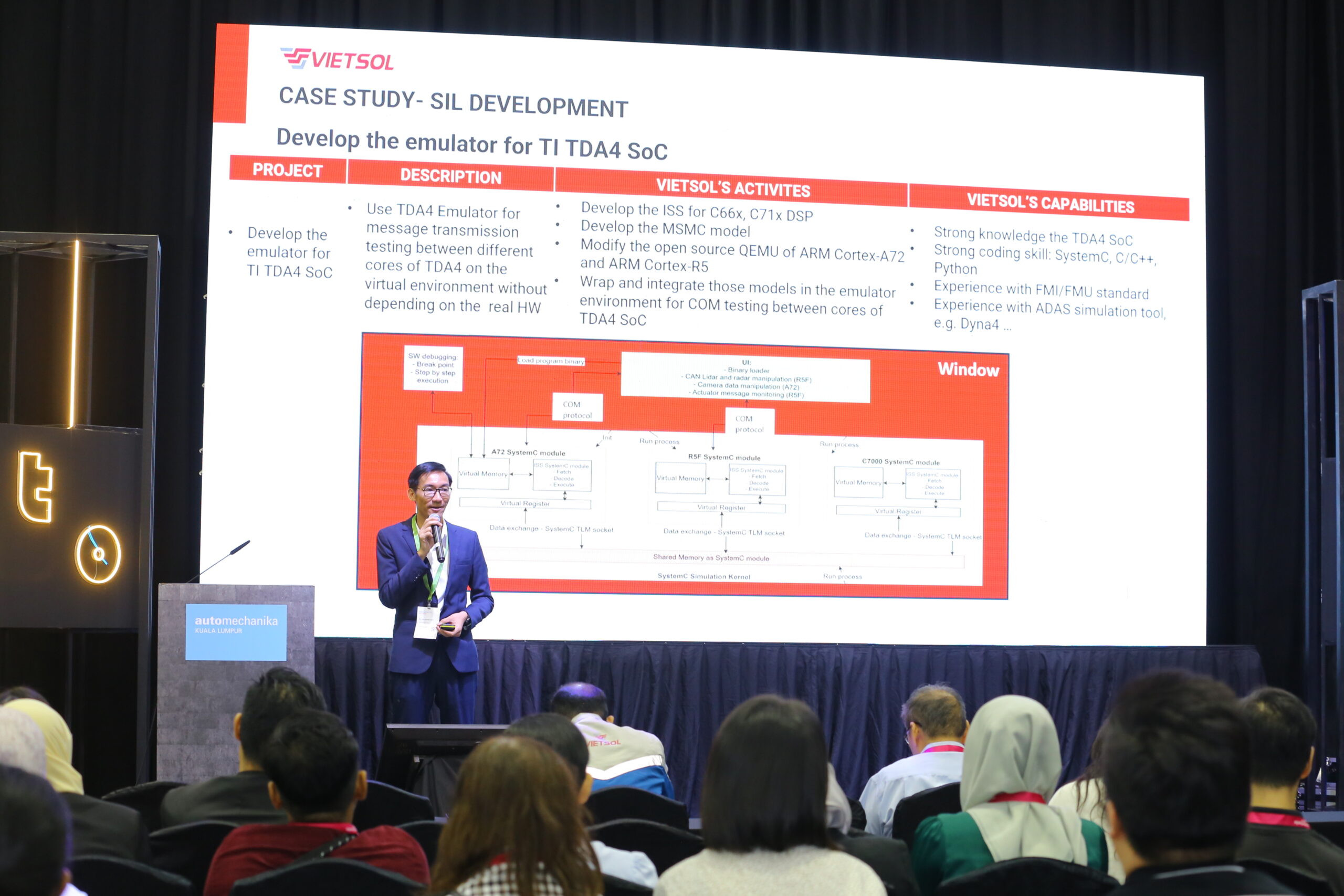
Strategic Presence in Edge AI Thought Leadership
Vietsol’s delegation included Mr. Nguyen Quoc Tuan (CEO) and Mr. Hoa Quoc Khanh (Project Manager, ADAS Testing & Manufacturing AI)—two figures actively shaping the firm’s innovation journey. Their keynote sessions drew notable attention from both technical professionals and business decision-makers across the international automotive scene.
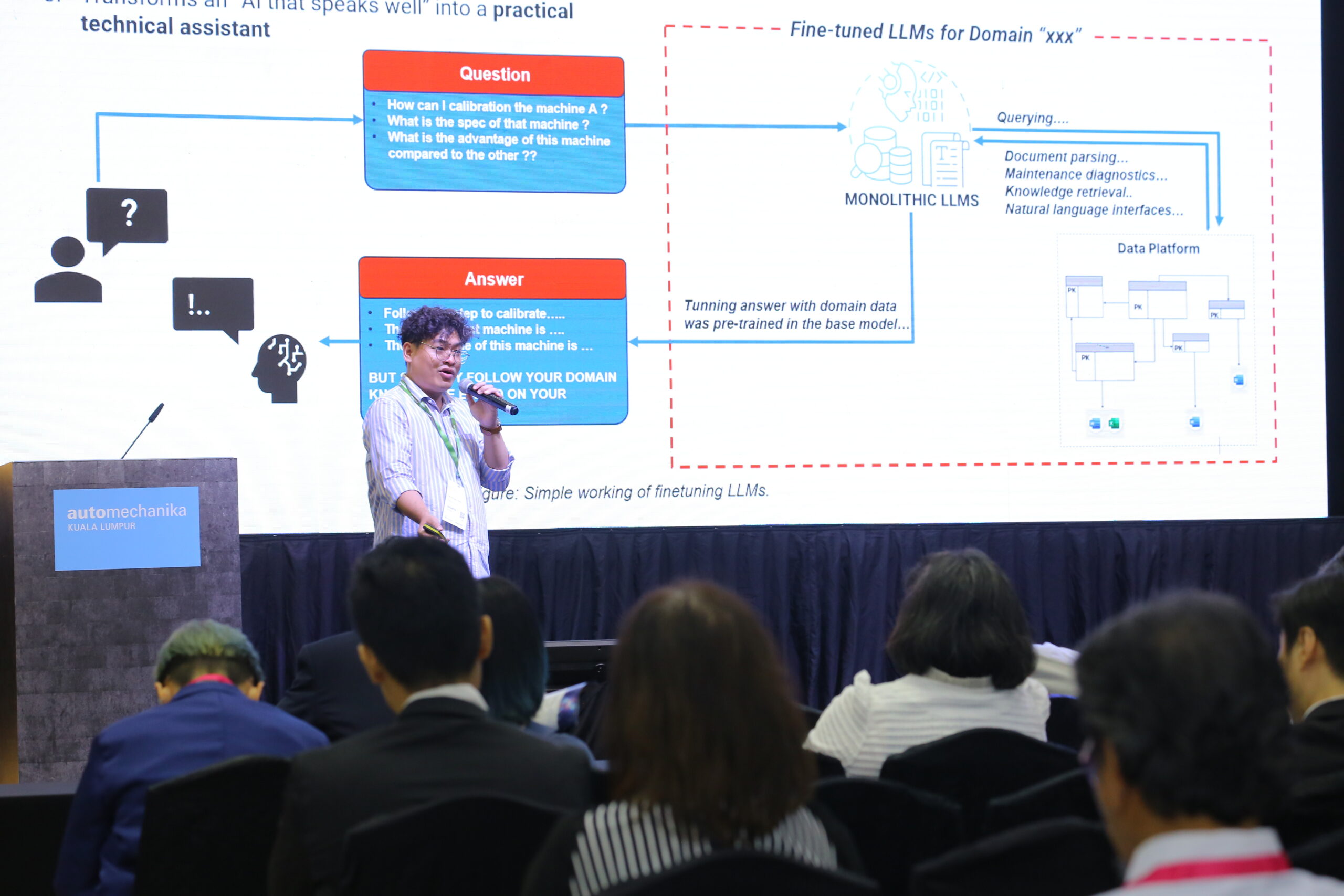
During his session on AI in automotive manufacturing, Mr. Khanh introduced a bold new perspective:
-
General-purpose AI chatbots may be powerful, but they are often ill-suited for the domain-specific needs of manufacturers.
-
Integrating modular AI components is akin to building a virtual team of experts—ask the right question to the right model and gain actionable, context-accurate insights.
-
The future lies in constructing AI Agents capable of perception, analysis, reasoning, and action—all fine-tuned to real-world operating environments.
Meaningful Engagement and Positive Feedback
Following their talks, the Vietsol team engaged in dynamic discussions and private follow-ups with several global stakeholders—particularly manufacturers curious about embedding Edge AI into production workflows.
The conversations reinforced a pivotal realization: many production teams still underappreciate the true potential of AI, especially in applications beyond predictive maintenance. Vietsol sees this as both a challenge and a strategic opportunity—to accompany and guide these enterprises along their digital transformation journeys.
Rethinking Product Strategy and Market Potential
Automechanika KL was also a moment of reflection and alignment. From observing other sessions, Vietsol gained valuable insights: the automotive manufacturing sector still holds vast untapped potential for advanced AI applications—ranging from workflow optimization to real-time defect detection and intelligent product personalization.
Moreover, many international OEMs and suppliers remain unfamiliar with Vietsol’s unique capabilities—particularly in tailoring high-performance AI software to constrained hardware environments. This presents a compelling frontier for strategic partnership and expansion.
Key Tech Trends Gaining Momentum
Several trends stood out at AMKL 2025 and are shaping the industry’s next wave of innovation:
-
Software-hardware co-optimization: enabling smarter performance without full hardware redesign.
-
Edge AI and Modular AI architectures: powering real-time production line monitoring, energy efficiency analysis, and anomaly detection.
-
AI-driven logistics orchestration: including component fault prediction and operational behavior analysis across manufacturing lines.
Vietsol is actively investing in these trends—not just within Vietnam, but also across its broader Southeast Asian roadmap.
A Message from Vietnam
When asked about global expectations for Vietnamese tech firms, Mr. Nguyen Quoc Tuan shared:
“We aim to be among the pioneers helping markets understand and adopt intelligent technologies—not only by providing solutions but by reshaping how industries think about building smart and sustainable mobility ecosystems.”
Strategic Implications for Vietnam’s Tech Landscape
Vietsol’s participation at Automechanika Kuala Lumpur 2025 also highlights a broader shift in how Vietnamese technology firms are being perceived on the global stage. As demand grows for regional providers with domain expertise in AI, embedded systems, and manufacturing automation, Vietnam has a timely opportunity to establish itself as more than just a sourcing destination — but as a serious innovation partner. Events like AMKL offer an ideal platform to not only showcase capability but also challenge legacy assumptions about the speed and quality of technological advancement coming out of Southeast Asia. Vietsol’s presence signaled that Vietnam is ready to co-create, lead conversations, and contribute to the future of mobility through smart, adaptive AI deployment.
Looking Ahead: See You at Automechanika Ho Chi Minh 2025
Next month, Vietsol will continue this journey at Automechanika Ho Chi Minh 2025. This time, in addition to keynote appearances, we will showcase a Proof of Concept (PoC) centered on the practical application of Edge AI in automotive manufacturing.
This project has been fully engineered for real-world deployment, empowering factories to boost operational efficiency without overhauling their entire infrastructure. We believe it will spark deeper technical conversations among manufacturers, solution partners, and ecosystem stakeholders alike.
See you in Ho Chi Minh City. Let’s shape the future of smart manufacturing-together.
RELATED NEWS
Vietsol at Automechanika 2026: From Kuala Lumpur to Ho Chi Minh City
Automechanika returns to Southeast Asia in 2026 with two landmark editions, and Vietsol will be present at both. As a Strategic Partner of Messe Frankfurt, Vietsol participates as Speaker and Exhibitor at Automechanika Kuala Lumpur 2026 (14 – 16 May, Kuala Lumpur Convention Centre, Malaysia) and Automechanika Ho Chi Minh City...
Vietsol Attends the 2026 SelectUSA Investment Summit
The U.S. automotive industry is undergoing one of its most significant structural shifts in decades. Reshoring, electrification, and renewed manufacturing investment are redrawing the map of where opportunity exists. For companies in the automotive supply chain, the question is no longer whether to engage with the U.S. market, but how...
Digital Twin: The Decision Layer Modern Industry Can’t Ignore
Introduction Over the past decade, enterprise investment in data infrastructure – spanning IoT ecosystems, cloud platforms, and advanced operational technologies – has fundamentally transformed the industrial landscape. Today, manufacturing systems generate continuous streams of real-time data from sensors, machines, and production lines at a scale that was previously unimaginable. Yet...